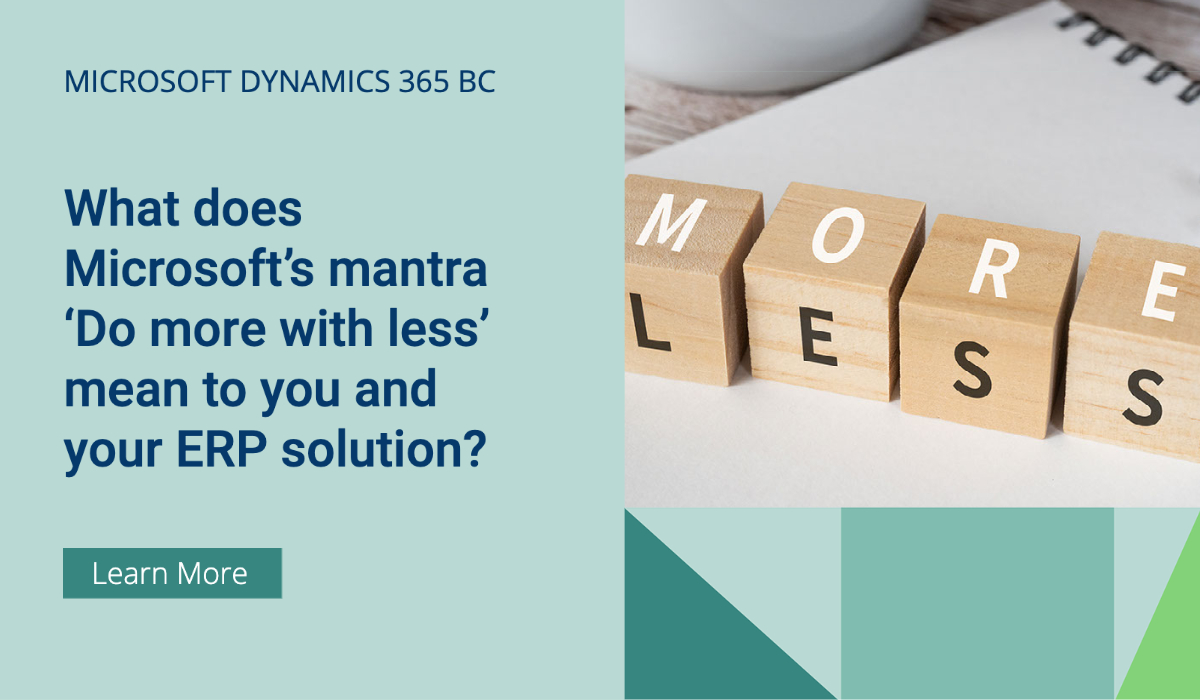
What does Microsoft’s mantra ‘Do more with less’ mean to you and your ERP solution?

Amidst widespread uncertainty, organisations face pressure these days to profitably innovate and improve resilience. But they must do that for less money. Managers see themselves confronted with recession, inflation, energy costs and war. They’ve made “Do more with less” the order of the day across organisations of all sizes.

After two years of heavy investment, many businesses are reducing capital spending on technology and taking a closer look at IT outlays and ROI. What does this mean for your organisation? And how can you best do more with less?

At the end of 2022, Microsoft launched a new campaign theme in response to these global economic challenges: ‘Do more with less’. In a message to partners and employees, Microsoft’s CEO Satya Nadella said, ‘You are the change agents who make doing more with less possible. Less time, less cost and less complexity. But with more innovation, more agility and more resilience. Doing less with more doesn’t mean working harder and longer’.

Here are a few ideas on how you can do more with less in the Dynamics 365 ERP domain.

Moving from on-premise to the cloud 

The use of on-premise software includes many different cost categories. Some of them are difficult to trace; some are even poorly visible. In addition, many of these costs are unpredictable and therefore difficult to budget. Moving your ERP solution to the cloud means outsourcing the management and administration of the solution at a guaranteed quality level and fixed, predictable and lower total costs.

Switching from customisations to standard solutions

Customisations are among the most expensive parts of your ERP solution – in the purchase, the implementation and in constantly adapting to new wishes and new versions. Switching to the use of standard extensions or ISV solutions will help you limit your cost at a higher level of quality, documentation and support. This works for Dynamics 365 Business Central and also other Microsoft apps such as Teams, Excel and Outlook.

Remove exotic requirements from your list 

Preventing additional and often unnecessary costs requires a certain level of self-control when drawing up the requirements and wishes packages. If you manage to avoid any exotic requirements, you’ll benefit from lower costs, less project risk and a shorter lead time to go live.

As a current or future user of Microsoft Dynamics 365 Business Central, you can do much more with less when you make the most of the standard solution, increase automation and take advantage of the many extensions that are available out of the box.

Interested in understanding what that could look like for your organisation? Then get in touch: https://www.brooklandsolutions.com/contact/

June 26, 2023

RECENT POSTS

  • At a Glance From April 2026, HMRC’s Making Tax Digital for Income Tax Self Assessment (MTD for ITSA) becomes mandatory for self-employed individuals and landlords earning over £50,000. Businesses must maintain digital records and file quarterly updates. Brookland Solutions helps SMEs prepare through Dynamics 365 Business Central integration, training, and ongoing compliance support. What is HMRC’s Making Tax Digital April 2026 Deadline? As April 2026 draws closer, individuals and businesses may have to make significant changes regarding Making Tax Digital (MTD). The UK Government introduced MTD for VAT-registered businesses in 2019, and it’s now a mandatory exercise. By April 2026, MTD will create a significant change to the UK tax system by introducing Making Tax Digital for Income Tax Self Assessment (MTD for ITSA) to cover income tax for sole traders and landlords whose combined gross business and/or property income is £50,000. It’s valid to ask, “Do I have to use Making Tax Digital for my business?” If you haven’t started exploring how MTD affects you or your business yet, now is the right time to prepare for the shift. In our MTD-readiness guide, you’ll learn if your business will be impacted by the April 2026 deadline and how you can prepare in advance. Making Tax Digital April 2026 - What Does It Mean? From April 2026, MTD for ITSA will apply to: Self-employed individuals Landlords (those with income from UK property or overseas property) Partnerships with self-employed individuals, where the combined turnover crosses the threshold People with multiple income sources. For example, a self-employed individual who also has rental income Thresholds for Compliance: From April 2026: Those with a gross annual income over £50,000 From April 2027: Those with income over £30,000 From April 2028: Those with income over £20,000 These thresholds are for gross business/ trading and/or property income before expenses, not income from profit. What Do the HMRC Making Tax Digital 2026 Changes Mean for Your Business? If these upcoming changes apply to you, you’ll need to: Start Maintaining Digital Records Keeping paper trails or spreadsheets isn’t enough (unless spreadsheets are used via bridging software). You’ll also need to keep digital records of your income and expenses, which is best done with MTD-compatible software in Business Central. Start logging business expenses, sales, income, and bank transactions. Take photos of receipts and upload them to the records. Submit Quarterly Updates Instead of one annual tax return, from April 2026, you’ll need to send four quarterly updates. These updates report your tax position after every quarter, lowering the load and stress of the year-end rush. Remember to submit updates by: August 7 (for quarter ending July 5) November 7 (for quarter ending Oct 5) February 7 (for quarter ending January 5) May 7 (for quarter ending April 5) Create a Final Declaration You’ll also need to send an End of Period Statement (EoPS) and a Final Declaration at the end of the tax year, replacing the traditional self-assessment exercise. Common Making Tax Digital Problems Businesses May Face Ahead of MTD 2026 In the rush to meet the upcoming deadline, your business may face some common Making Tax Digital problems. Here’s how you can resolve them: 1. Using Incompatible or Unapproved Software Making Tax Digital mandates the use of compatible and approved software for submissions. You may be risking non-compliance by relying on outdated accounting systems or spreadsheets for digital record-keeping and quarterly submissions. You don’t need to look for another MTD-compatible software when your Dynamics ERPs, like NAV (some versions) and Business Central, have MTD features built in. If you’re already familiar with BC but want to get started with MTD, connect with our team today. 2. Lacking MTD Integration with ERP Without MTD software integrated with your broader finance and accounting systems, you’re likely to struggle with reporting gaps, errors in data, data duplication, and related issues that can slow down your efforts and make you non-compliant. NAV and BC already unify your operations into one interconnected system, and pull information from various accounting programmes. You gain complete visibility into deadlines, ensuring you meet them on time. Solidify your MTD prep and reduce the chances of errors, duplication, and non-compliance with Dynamics ERPs. 3. Lack of Accountability Don’t assume that your accountant will handle everything for you, as this can be a major oversight. Without clear accountability and ownership, your hard work and prep to meet the HMRC Making Tax Digital 2026 deadline may fail. We recommend getting the right guidance and training on handling MTD with your existing systems. Brookland’s team can help if you’re already a BC user looking for training and support for setting up and managing MTD. Choosing the Right Software & Partner to Stay MTD-Compliant A 2021 HMRC report highlights that MTD for VAT helped 69% businesses experience at least one benefit, with 67% admitting that it lowered the chance of errors in their records. Along with working with the right software, you need the right partner to implement the right tools to simplify the MTD prep. Keep These Points in Mind When Looking for an MTD Software: Is it compatible and approved by the HMRC? Does it support digital record keeping? Can it check and submit automatically? Will my tax information be secured? Will it be easy to use? Will it have a steep learning curve? Brookland Solutions is a Silver-certified Microsoft Partner that has helped many businesses, SMEs, and group companies simplify their VAT submissions and returns through NAV and Business Central. With our deep industry knowledge and experience handling complex needs, we’re confident that our team is ready to support self-employed individuals and traders in preparing for the HMRC Making Tax Digital changes in 2026 and beyond. Key Actions to Take Now to Ensure MTD‑Ready Systems Preparing for the Making Tax Digital April 2026 changes isn’t just a legal need. Your business should see it as an opportunity to upgrade old systems and create a strong foundation for better and efficient financial management. Investing in Microsoft Dynamics 365 Business Central, an ERP built for customisation, can not only help you with tax compliance but also streamline your overall business operations. Brookland Solutions can help in implementing, consulting, training, and support services for your Dynamics ERP. If you’re not a Dynamics user but are interested in implementing the MTD solution for your business, contact us today.

How to Prepare for Making Tax Digital Before April 2026

November 26, 2025|

At a Glance From April 2026, HMRC’s Making Tax Digital for Income Tax Self Assessment (MTD for ITSA) becomes mandatory for self-employed individuals and landlords earning over £50,000. Businesses must maintain digital records and file [...]

Top 9 Mistakes SMEs Make When Setting Up MTD

November 19, 2025|

At a Glance Many UK SMEs still struggle with Making Tax Digital due to multiple issues, ranging from non-compliant software to poor data handling. Brookland Solutions can help streamline MTD compliance through Microsoft Dynamics 365 [...]

  • business central GDPR, two people shaking hands in front of a screen with a secure padlock image.

Benefits of Business Central For UK GDPR Compliance

November 12, 2025|

At a Glance Complying with GDPR is essential for UK SMEs handling personal data. Microsoft Dynamics 365 Business Central simplifies this task with its built-in tools for classification, correction, deletion, and anonymisation. With Brookland Solutions’ [...]