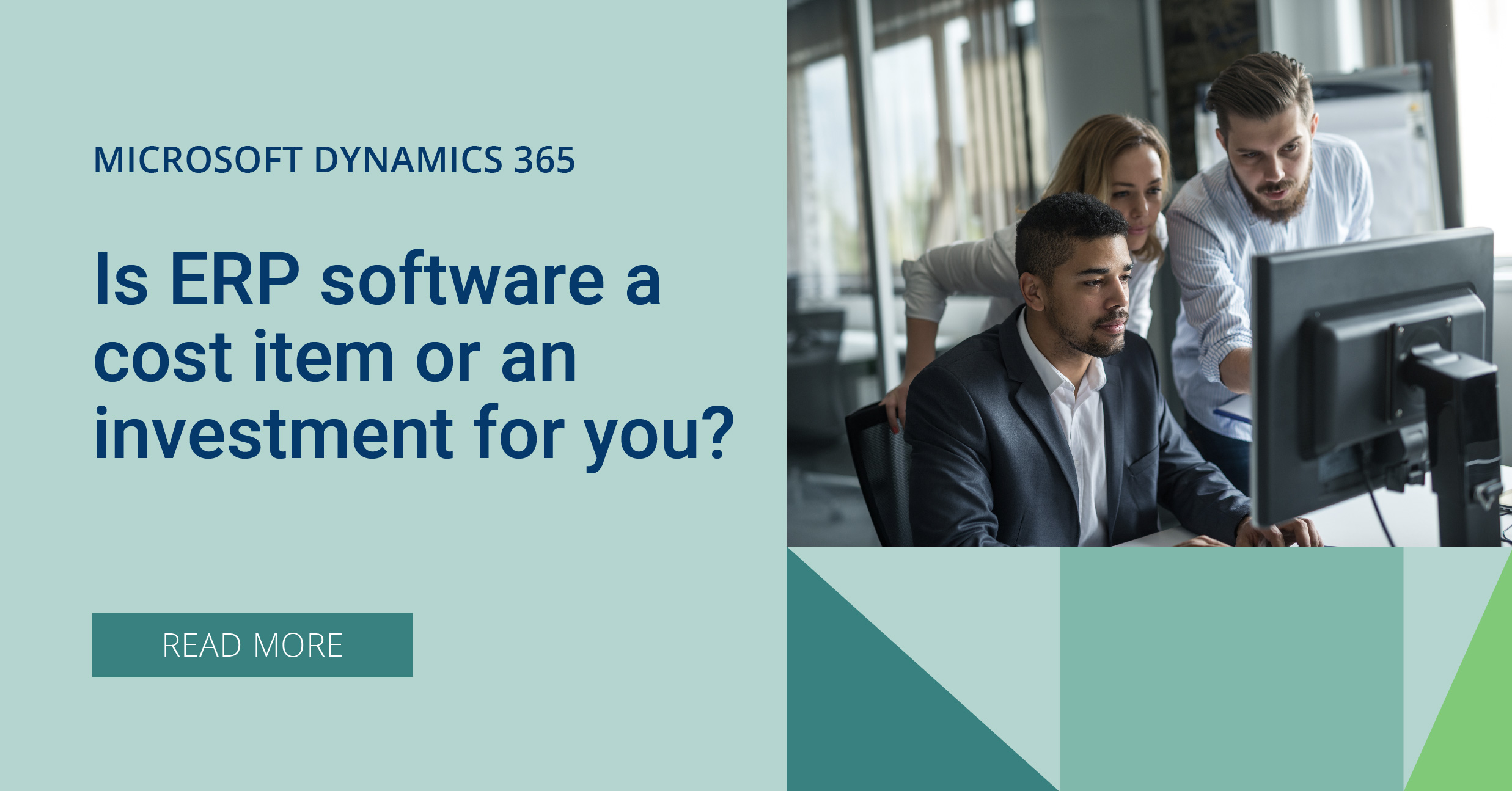
Is ERP software a cost item or an investment for you?

Traditionally, ERP software has been regarded as a cost. During the selection and implementation phases, most organizations have tried to do everything to limit costs as much as possible. 

In today’s modern world, the role of good ERP implementations is widely accepted in most boardrooms. A growing number of organisations have accepted that reliable data, customer-oriented business processes and the right mindset heavily influence the results of any company. 

However, cost-oriented thinking is still influencing organizations greatly – especially in SMB markets. This is not always beneficial! 

Many companies are plainly unhappy with their current, outdated ERP software. Widespread complaints include too much complexity in usage, shortcomings in innovation and insufficient flexibility. Forced by necessity, end users are taking refuge in Excel or Access – with all the predictable consequences. 

It’s surprising that these companies still persist in using an outdated ERP system. The argument that ‘the investment has not yet been depreciated’ proves to be more important than a decrease in reliability of delivery, customer loss and increasing costs of failure. Far too often, the cup of poison is emptied to the bottom before a better solution is sought. 

The element of cost still plays a substantial role in choosing a new ERP software. Without any hesitation, a potential vendor can be discarded on the basis of an initial price difference of just 3 per cent, even though that vendor offers a 30 per cent more advantageous prospect in terms of innovation and continuity.

Do you belong to that category of companies who are unhappy with their current ERP? If so, it’s interesting to think back to the moment you selected your current solution. Do you still remember which systems and vendors were on your shortlist? 

Imagine where you might have ended up with those solutions. Perhaps you would conclude that with a different choice, today there would not be the necessity to completely replace your ERP. You might realise that there would be successive versions with functionality that you now need urgently. You might decide that the other implementation partner did make good on his promise to invest actively in their knowledge of your industry.

When you no longer see ERP software as a cost – but rather as an investment – you create a different perspective to approach the selection. The yield of your new software system, the number of years you will be able to use it – and hence depreciate the system – and the possibility of growing to successive generations of the software suddenly become much more important. 

In this way, there is a good chance that you will select a more effective and profitable solution!

If you are preparing to make a change to Dynamics 365 Business Central, this might be the right time to act. By contacting us today, you will be taking the first step towards this change. 

Get in touch

December 15, 2022

RECENT POSTS

  • At a Glance From April 2026, HMRC’s Making Tax Digital for Income Tax Self Assessment (MTD for ITSA) becomes mandatory for self-employed individuals and landlords earning over £50,000. Businesses must maintain digital records and file quarterly updates. Brookland Solutions helps SMEs prepare through Dynamics 365 Business Central integration, training, and ongoing compliance support. What is HMRC’s Making Tax Digital April 2026 Deadline? As April 2026 draws closer, individuals and businesses may have to make significant changes regarding Making Tax Digital (MTD). The UK Government introduced MTD for VAT-registered businesses in 2019, and it’s now a mandatory exercise. By April 2026, MTD will create a significant change to the UK tax system by introducing Making Tax Digital for Income Tax Self Assessment (MTD for ITSA) to cover income tax for sole traders and landlords whose combined gross business and/or property income is £50,000. It’s valid to ask, “Do I have to use Making Tax Digital for my business?” If you haven’t started exploring how MTD affects you or your business yet, now is the right time to prepare for the shift. In our MTD-readiness guide, you’ll learn if your business will be impacted by the April 2026 deadline and how you can prepare in advance. Making Tax Digital April 2026 - What Does It Mean? From April 2026, MTD for ITSA will apply to: Self-employed individuals Landlords (those with income from UK property or overseas property) Partnerships with self-employed individuals, where the combined turnover crosses the threshold People with multiple income sources. For example, a self-employed individual who also has rental income Thresholds for Compliance: From April 2026: Those with a gross annual income over £50,000 From April 2027: Those with income over £30,000 From April 2028: Those with income over £20,000 These thresholds are for gross business/ trading and/or property income before expenses, not income from profit. What Do the HMRC Making Tax Digital 2026 Changes Mean for Your Business? If these upcoming changes apply to you, you’ll need to: Start Maintaining Digital Records Keeping paper trails or spreadsheets isn’t enough (unless spreadsheets are used via bridging software). You’ll also need to keep digital records of your income and expenses, which is best done with MTD-compatible software in Business Central. Start logging business expenses, sales, income, and bank transactions. Take photos of receipts and upload them to the records. Submit Quarterly Updates Instead of one annual tax return, from April 2026, you’ll need to send four quarterly updates. These updates report your tax position after every quarter, lowering the load and stress of the year-end rush. Remember to submit updates by: August 7 (for quarter ending July 5) November 7 (for quarter ending Oct 5) February 7 (for quarter ending January 5) May 7 (for quarter ending April 5) Create a Final Declaration You’ll also need to send an End of Period Statement (EoPS) and a Final Declaration at the end of the tax year, replacing the traditional self-assessment exercise. Common Making Tax Digital Problems Businesses May Face Ahead of MTD 2026 In the rush to meet the upcoming deadline, your business may face some common Making Tax Digital problems. Here’s how you can resolve them: 1. Using Incompatible or Unapproved Software Making Tax Digital mandates the use of compatible and approved software for submissions. You may be risking non-compliance by relying on outdated accounting systems or spreadsheets for digital record-keeping and quarterly submissions. You don’t need to look for another MTD-compatible software when your Dynamics ERPs, like NAV (some versions) and Business Central, have MTD features built in. If you’re already familiar with BC but want to get started with MTD, connect with our team today. 2. Lacking MTD Integration with ERP Without MTD software integrated with your broader finance and accounting systems, you’re likely to struggle with reporting gaps, errors in data, data duplication, and related issues that can slow down your efforts and make you non-compliant. NAV and BC already unify your operations into one interconnected system, and pull information from various accounting programmes. You gain complete visibility into deadlines, ensuring you meet them on time. Solidify your MTD prep and reduce the chances of errors, duplication, and non-compliance with Dynamics ERPs. 3. Lack of Accountability Don’t assume that your accountant will handle everything for you, as this can be a major oversight. Without clear accountability and ownership, your hard work and prep to meet the HMRC Making Tax Digital 2026 deadline may fail. We recommend getting the right guidance and training on handling MTD with your existing systems. Brookland’s team can help if you’re already a BC user looking for training and support for setting up and managing MTD. Choosing the Right Software & Partner to Stay MTD-Compliant A 2021 HMRC report highlights that MTD for VAT helped 69% businesses experience at least one benefit, with 67% admitting that it lowered the chance of errors in their records. Along with working with the right software, you need the right partner to implement the right tools to simplify the MTD prep. Keep These Points in Mind When Looking for an MTD Software: Is it compatible and approved by the HMRC? Does it support digital record keeping? Can it check and submit automatically? Will my tax information be secured? Will it be easy to use? Will it have a steep learning curve? Brookland Solutions is a Silver-certified Microsoft Partner that has helped many businesses, SMEs, and group companies simplify their VAT submissions and returns through NAV and Business Central. With our deep industry knowledge and experience handling complex needs, we’re confident that our team is ready to support self-employed individuals and traders in preparing for the HMRC Making Tax Digital changes in 2026 and beyond. Key Actions to Take Now to Ensure MTD‑Ready Systems Preparing for the Making Tax Digital April 2026 changes isn’t just a legal need. Your business should see it as an opportunity to upgrade old systems and create a strong foundation for better and efficient financial management. Investing in Microsoft Dynamics 365 Business Central, an ERP built for customisation, can not only help you with tax compliance but also streamline your overall business operations. Brookland Solutions can help in implementing, consulting, training, and support services for your Dynamics ERP. If you’re not a Dynamics user but are interested in implementing the MTD solution for your business, contact us today.

How to Prepare for Making Tax Digital Before April 2026

November 26, 2025|

At a Glance From April 2026, HMRC’s Making Tax Digital for Income Tax Self Assessment (MTD for ITSA) becomes mandatory for self-employed individuals and landlords earning over £50,000. Businesses must maintain digital records and file [...]

Top 9 Mistakes SMEs Make When Setting Up MTD

November 19, 2025|

At a Glance Many UK SMEs still struggle with Making Tax Digital due to multiple issues, ranging from non-compliant software to poor data handling. Brookland Solutions can help streamline MTD compliance through Microsoft Dynamics 365 [...]

  • business central GDPR, two people shaking hands in front of a screen with a secure padlock image.

Benefits of Business Central For UK GDPR Compliance

November 12, 2025|

At a Glance Complying with GDPR is essential for UK SMEs handling personal data. Microsoft Dynamics 365 Business Central simplifies this task with its built-in tools for classification, correction, deletion, and anonymisation. With Brookland Solutions’ [...]