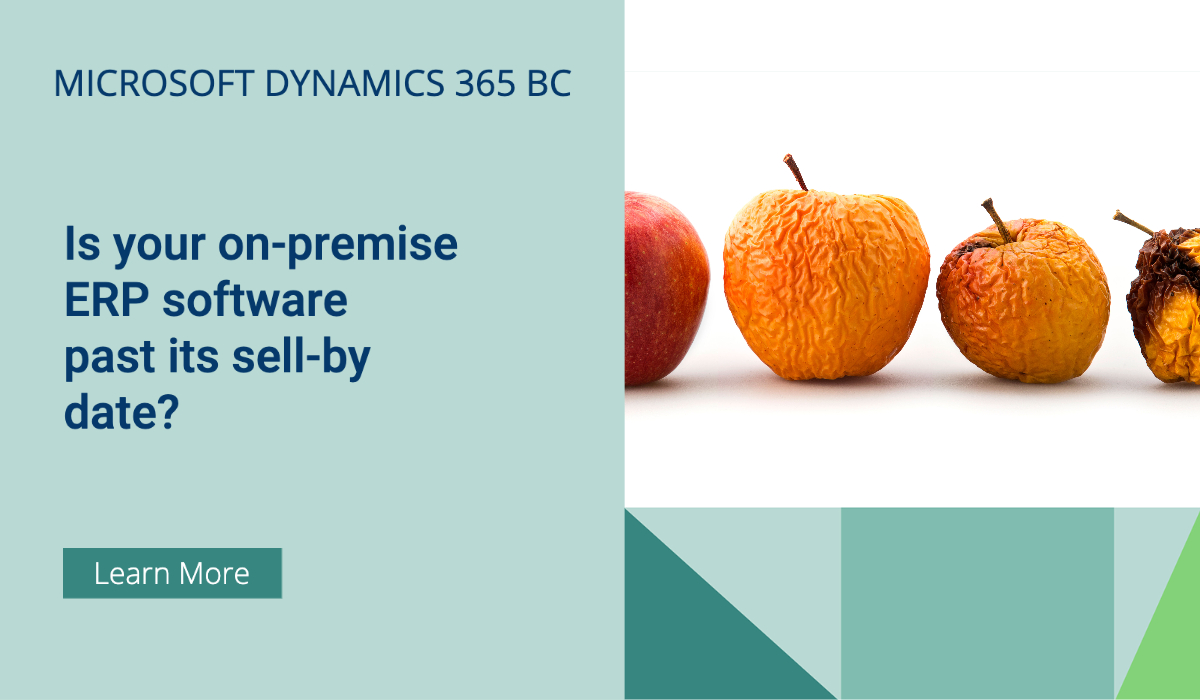
Is your on-premise ERP software past its sell-by date?
There are still many organisations using old, often outdated ERP software. Sometimes they use the latest version of a solution that lacks innovation, and sometimes it’s an older version of an innovative and modern solution, waiting for an upgrade. There are of course thousands of reasons why it’s not convenient to switch to a more modern system or version now.
But are you fully aware of the business impact of continuing the use of your outdated solution? It is like driving an old, rattling car on a motorway – while the competition is smoothly overtaking you at great speed. How long can your business afford this?
Continuing to work with an outdated ERP system involves a number of risks, and it’s important for you to be aware of them. In this blog post, we discuss five of these risks.
1. Missing innovation
ERP vendors spend their R&D budgets on their modern, cloud-based ERP solutions. Staying with an outdated solution means that you are missing out on new innovations, such as Microsoft’s ChatGPT-based Dynamics 365 Copilot. This can result in declining competitiveness.
2. Higher Total Cost of Ownership
If you continue the use of your on-premise solution, you can expect a higher Total Cost of Ownership over time. This happens for two reasons: one, because of the continued investments to maintain your current IT infrastructure and second, because the cost of your software support is likely to increase.
3. Decreased security
Hackers and their methods become more sophisticated every single day, and they often focus specifically on older versions that have limited or no support. Continuing the use of an older system increases the risk of cyber-attacks.
4. Availability of knowledge
Implementation partners spend fortunes training their employees. Unfortunately for you, they do that only in the new(er) versions. Staying on an outdated solution results in a decreasing availability of knowledge as older consultants start to retire.
5. Dissatisfied employees and customers
Not many people like to work with outdated solutions since everybody knows the benefits of a modern user interface from their phones. This is the same story for outdated business processes. Continuing to use an old solution increases the likelihood of dissatisfied employees and customers.
ERP systems are the heart of your information systems. The quality of your solution, your business processes and your data determine your business performance and your financial results. These are very strong reasons not to be left behind with an older system.
Don’t forget that it will take your organisation at least 6 to 12 months to migrate to a modern solution – even if you decide to make the change today.
That’s why it’s so important to ask yourself: how much longer can your business afford to continue working with an outdated ERP solution?
Have we convinced you to look into moving to a more modern ERP system?
August 16, 2023
RECENT POSTS

What Should UK Construction Firms Look for When Choosing an ERP System?
What Should UK Construction Firms Look for When Choosing an ERP System? At a Glance Construction firms need ERP systems that can connect financial information with the realities of managing multiple projects, budgets, resources and [...]

Is Business Central the Right ERP for a Growing Wholesale or Distribution Business?
Is Business Central the Right ERP for a Growing Wholesale or Distribution Business? At a Glance Growing wholesale and distribution businesses can outgrow spreadsheets and legacy systems as order volumes, inventory, locations and operational complexity [...]

What Is Group Making Tax Digital and Does It Apply to Your Business?
What Is Group Making Tax Digital and Does It Apply to Your Business? At a Glance Group Making Tax Digital applies MTD for VAT requirements to businesses registered with HMRC as a VAT group. Member [...]