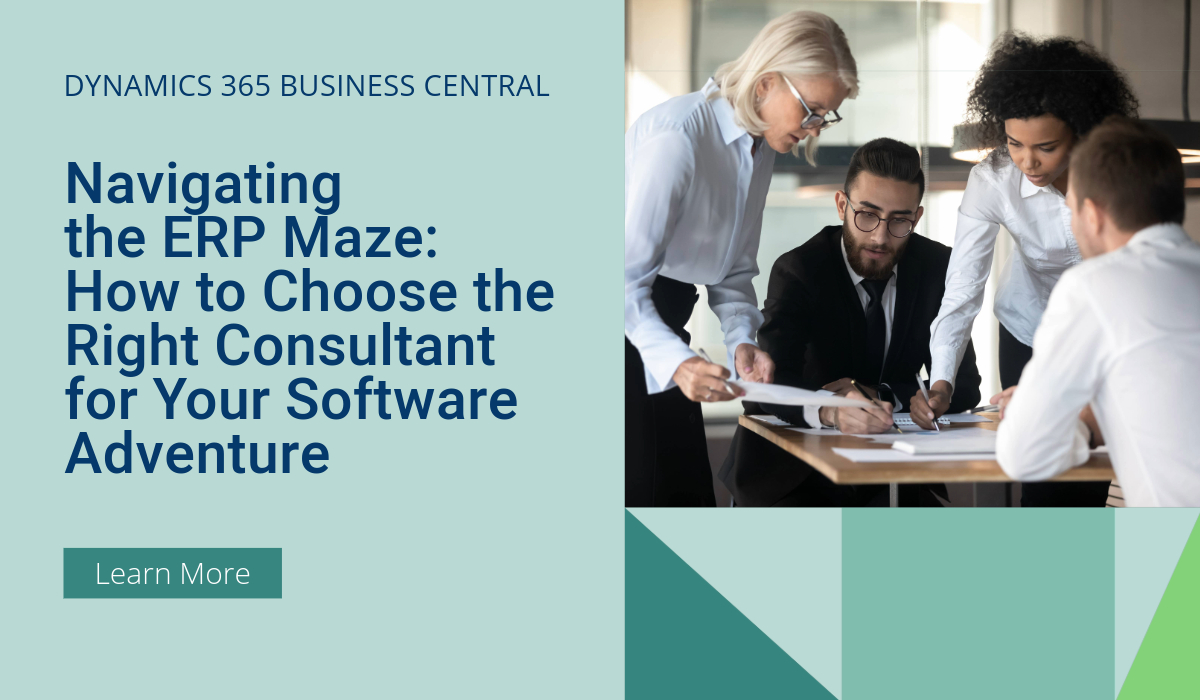
Navigating the ERP Maze: How to Choose the Right Consultant for Your Software Adventure

Navigating the ERP Maze: How to Choose the Right Consultant for Your Software Adventure

Embarking on the journey of selecting, contracting and implementing ERP software is akin to navigating a complex maze where wrong turns can lead to extensive investments and the looming spectre of failure.

The risk is high, but the risk of not modernising is even greater, making the role of an ERP selection consultant crucial. In a realm where inexperience is the norm for many organisations, the need for external guidance becomes evident. But how do you ensure you’re choosing the right consultant to steer your ship through the ERP storm?

First and foremost, ensure your shortlisted consultants are unbiased – with no hidden interests in your final decisions. Just as selecting the right ERP solution is pivotal, understanding the success rate of your potential consultants in previous projects is equally crucial. It’s not just about their track record, but how well they align with your unique business objectives.

Sector-specific knowledge and experience form the bedrock of a fruitful collaboration. Request solid evidence from a reference list that proves their expertise in your industry. Don’t shy away from contacting these references to get a firsthand account of their experiences.

Considering you’ll be in close quarters with your consultant for months, evaluating the cultural fit between their consultancy and your company is paramount. It’s not just about technology and functionality; it’s about comprehending implementation projects and organisational change management. Can they seamlessly operate at the C-level? In a landscape where directors play a pivotal role, effective communication at this level is indispensable.

Don’t settle for tunnel vision. Opt for consultants with a breadth of expertise, an understanding of multiple systems, experience with various technologies and familiarity with different platforms. The ability to see the bigger picture significantly enhances the chances of project success.

Before sealing the deal, meet the proposed consultant in person. In the world of ERP projects, you’re not doing business with a logo, but with a person. Ensure there’s a connection beyond the contractual obligations.

While cost is a factor, don’t let it be the sole determinant. A good consultant is an investment that safeguards you from potential pitfalls. Most organisations replace ERP systems every 8 to 10 years, making it crucial to find a selection consultant who truly understands the nuances of the process.

In the intricate dance of ERP selection, the right consultant is your guiding partner. Choose wisely, and let the symphony of successful implementations resonate through your organisation for years to come.

Are you looking for a reliable partner for your ERP transition?

Get in touch: https://bit.ly/3k71yLx 

January 24, 2024

RECENT POSTS

  • At a Glance From April 2026, HMRC’s Making Tax Digital for Income Tax Self Assessment (MTD for ITSA) becomes mandatory for self-employed individuals and landlords earning over £50,000. Businesses must maintain digital records and file quarterly updates. Brookland Solutions helps SMEs prepare through Dynamics 365 Business Central integration, training, and ongoing compliance support. What is HMRC’s Making Tax Digital April 2026 Deadline? As April 2026 draws closer, individuals and businesses may have to make significant changes regarding Making Tax Digital (MTD). The UK Government introduced MTD for VAT-registered businesses in 2019, and it’s now a mandatory exercise. By April 2026, MTD will create a significant change to the UK tax system by introducing Making Tax Digital for Income Tax Self Assessment (MTD for ITSA) to cover income tax for sole traders and landlords whose combined gross business and/or property income is £50,000. It’s valid to ask, “Do I have to use Making Tax Digital for my business?” If you haven’t started exploring how MTD affects you or your business yet, now is the right time to prepare for the shift. In our MTD-readiness guide, you’ll learn if your business will be impacted by the April 2026 deadline and how you can prepare in advance. Making Tax Digital April 2026 - What Does It Mean? From April 2026, MTD for ITSA will apply to: Self-employed individuals Landlords (those with income from UK property or overseas property) Partnerships with self-employed individuals, where the combined turnover crosses the threshold People with multiple income sources. For example, a self-employed individual who also has rental income Thresholds for Compliance: From April 2026: Those with a gross annual income over £50,000 From April 2027: Those with income over £30,000 From April 2028: Those with income over £20,000 These thresholds are for gross business/ trading and/or property income before expenses, not income from profit. What Do the HMRC Making Tax Digital 2026 Changes Mean for Your Business? If these upcoming changes apply to you, you’ll need to: Start Maintaining Digital Records Keeping paper trails or spreadsheets isn’t enough (unless spreadsheets are used via bridging software). You’ll also need to keep digital records of your income and expenses, which is best done with MTD-compatible software in Business Central. Start logging business expenses, sales, income, and bank transactions. Take photos of receipts and upload them to the records. Submit Quarterly Updates Instead of one annual tax return, from April 2026, you’ll need to send four quarterly updates. These updates report your tax position after every quarter, lowering the load and stress of the year-end rush. Remember to submit updates by: August 7 (for quarter ending July 5) November 7 (for quarter ending Oct 5) February 7 (for quarter ending January 5) May 7 (for quarter ending April 5) Create a Final Declaration You’ll also need to send an End of Period Statement (EoPS) and a Final Declaration at the end of the tax year, replacing the traditional self-assessment exercise. Common Making Tax Digital Problems Businesses May Face Ahead of MTD 2026 In the rush to meet the upcoming deadline, your business may face some common Making Tax Digital problems. Here’s how you can resolve them: 1. Using Incompatible or Unapproved Software Making Tax Digital mandates the use of compatible and approved software for submissions. You may be risking non-compliance by relying on outdated accounting systems or spreadsheets for digital record-keeping and quarterly submissions. You don’t need to look for another MTD-compatible software when your Dynamics ERPs, like NAV (some versions) and Business Central, have MTD features built in. If you’re already familiar with BC but want to get started with MTD, connect with our team today. 2. Lacking MTD Integration with ERP Without MTD software integrated with your broader finance and accounting systems, you’re likely to struggle with reporting gaps, errors in data, data duplication, and related issues that can slow down your efforts and make you non-compliant. NAV and BC already unify your operations into one interconnected system, and pull information from various accounting programmes. You gain complete visibility into deadlines, ensuring you meet them on time. Solidify your MTD prep and reduce the chances of errors, duplication, and non-compliance with Dynamics ERPs. 3. Lack of Accountability Don’t assume that your accountant will handle everything for you, as this can be a major oversight. Without clear accountability and ownership, your hard work and prep to meet the HMRC Making Tax Digital 2026 deadline may fail. We recommend getting the right guidance and training on handling MTD with your existing systems. Brookland’s team can help if you’re already a BC user looking for training and support for setting up and managing MTD. Choosing the Right Software & Partner to Stay MTD-Compliant A 2021 HMRC report highlights that MTD for VAT helped 69% businesses experience at least one benefit, with 67% admitting that it lowered the chance of errors in their records. Along with working with the right software, you need the right partner to implement the right tools to simplify the MTD prep. Keep These Points in Mind When Looking for an MTD Software: Is it compatible and approved by the HMRC? Does it support digital record keeping? Can it check and submit automatically? Will my tax information be secured? Will it be easy to use? Will it have a steep learning curve? Brookland Solutions is a Silver-certified Microsoft Partner that has helped many businesses, SMEs, and group companies simplify their VAT submissions and returns through NAV and Business Central. With our deep industry knowledge and experience handling complex needs, we’re confident that our team is ready to support self-employed individuals and traders in preparing for the HMRC Making Tax Digital changes in 2026 and beyond. Key Actions to Take Now to Ensure MTD‑Ready Systems Preparing for the Making Tax Digital April 2026 changes isn’t just a legal need. Your business should see it as an opportunity to upgrade old systems and create a strong foundation for better and efficient financial management. Investing in Microsoft Dynamics 365 Business Central, an ERP built for customisation, can not only help you with tax compliance but also streamline your overall business operations. Brookland Solutions can help in implementing, consulting, training, and support services for your Dynamics ERP. If you’re not a Dynamics user but are interested in implementing the MTD solution for your business, contact us today.

How to Prepare for Making Tax Digital Before April 2026

November 26, 2025|

At a Glance From April 2026, HMRC’s Making Tax Digital for Income Tax Self Assessment (MTD for ITSA) becomes mandatory for self-employed individuals and landlords earning over £50,000. Businesses must maintain digital records and file [...]

Top 9 Mistakes SMEs Make When Setting Up MTD

November 19, 2025|

At a Glance Many UK SMEs still struggle with Making Tax Digital due to multiple issues, ranging from non-compliant software to poor data handling. Brookland Solutions can help streamline MTD compliance through Microsoft Dynamics 365 [...]

  • business central GDPR, two people shaking hands in front of a screen with a secure padlock image.

Benefits of Business Central For UK GDPR Compliance

November 12, 2025|

At a Glance Complying with GDPR is essential for UK SMEs handling personal data. Microsoft Dynamics 365 Business Central simplifies this task with its built-in tools for classification, correction, deletion, and anonymisation. With Brookland Solutions’ [...]